Abrasives Products & Manufacturing
Text
3M INNOVATIONS IN ABRASIVES PRODUCTS
Abrasives: The Sandpaper Story
3M began manufacturing a single product, abrasive sandpaper, in 1905 at a plant in Duluth. Sandpaper was still the only product when the company relocated to Saint Paul in 1910. The first important markets for 3M abrasive sandpaper were furniture and woodworking plants and then the automotive industry. William L. McKnight, the first sales manager, his successor Archibald G. Bush, and other salesmen visited workers in the plants and factories to see how sandpaper performed and how it could be improved. Problems with sandpaper quality led 3M to establish its first research lab and quality control program in 1914.Roofing Granules
Roofing granules were developed in 1932. They are made of crushed rock and coated with ceramics in various durable colors, which can be embedded in asphalt to form shingles or other roofing materials. By 1947, 3M was producing enough roofing granules to cover 1,200,000 houses.Non-Slip Surfacing
3M introduced “Saftey-Walk” waterproof non-slip surfacing materials in 1940. They helped improve safety on floors, staircases, ramps, and sidewalks, especially those with metal surfaces.PRODUCTION & FACILITIES EXPANSION
Abrasives Manufacturing
3M manufactured sandpaper, “Three-M-ite” abrasive cloth, and "Three-M-ite Wetordry" sandpaper in its first two buildings in Saint Paul. In 1955, 3M's Maker No. 6 was located in Building 47, which became the world's largest abrasives manufacturing plant."The new Maker represents the combined technical skills of 3M’s engineering, research and production staffs and is constructed to produce ‘the coated abrasives of tomorrow’.” — 3M Megaphone, February 1955
3M MARKETING OF ABRASIVES PRODUCTS
Promoting Sandpaper
Most 3M sandpaper and abrasives were made for commercial and industrial uses. However, the company began to market directly to consumers as early as 1921. Sandpaper and other abrasives accounted for almost all 3M product sales in 1925. By 1949, abrasives were only one-fifth of total 3M sales as the company expanded into other products. Nonetheless, sandpaper was actively promoted for household uses.Files

Manufacturing Sandpaper, 3M
ca.1970 Image Courtesy of Minnesota Historical Society Collections: http://www.mnhs.org/collections/
Man Uses Sandpaper for Model Planes
Sandpaper had substantial demand from hobbyists and homemakers as well as industrial markets. | Source: Minnesota Historical Society
"Three-M-Mite" Abrasive Cloth
Early labelling for "Three-M-Mite" cloth, a product marketed for a variety of uses around the home and in mechanical work. | Source: Minnesota Historical Society
Hand Sanding an Auto Body, 1924
The first important markets for 3M abrasive sandpaper were furniture and woodworking plants and then the automotive industry. | Source: Minnesota Historical Society
Laboratory Testing
3M Scientists conducting product testing and research. | Source: Minnesota Historical Society
Roofing Granules
By 1947, 3M was producing enough roofing granules to cover 1,200,000 houses. | Source: Minnesota Historical Society
Advertisement for Non-Slip Surfacing
3M “Saftey-Walk” surfacing materials were marketed to improve safety on floors, staircases, ramps, and sidewalks, especially those with metal surfaces. | Source: Minnesota Historical Society
3M Campus, 1937
Aerial view of the 3M campus in 1937. | Source: Minnesota Historical Society
3M Campus, 1941
Aerial view of the 3M campus in 1941. | Source: Minnesota Historical Society
3M Campus, 1956
Aerial view of the 3M campus in 1956. | Source: Minnesota Historical Society
Buildings 1 and 2, 1921
Building 2 (left) and Building 1 (right), Forest Street, in 1921. | Source: Minnesota Historical Society
Building 2 in 1956
Building 2 after expansion. | Source: Minnesota Historical Society
Building 47
In 1955, 3M's Maker No. 6 was located in Building 47, which became the world's largest abrasives manufacturing plant. | Source: Minnesota Historical Society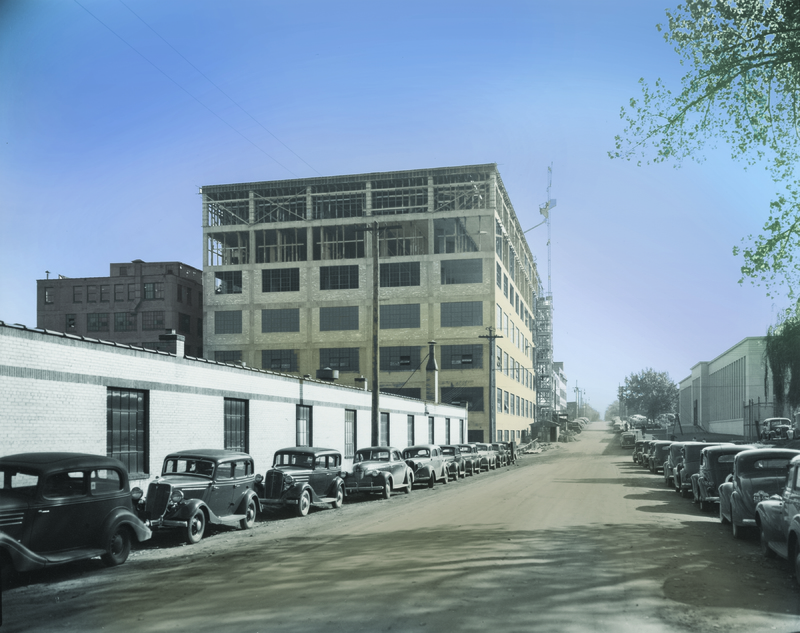
Building 20 expansion, 1940
Expanded construction of Building 20 in 1940, looking east along Fauquier (now Bush) Avenue. | Source: Minnesota Historical Society
Minerals Sorting
Source: Minnesota Historical Society
Minerals Sorting and Packing
Source: Minnesota Historical Society
Heavy Machinery
Men work amidst massive industrial machines at 3M manufacturing plant. | Source: Minnesota Historical Society
Retail Counter
Proprietor shows 3M "Wet-or-Dry" sandpaper to man at retail counter. | Source: Minnesota Historical Society
"Sandy Smooth" Advertisement Campaign
Sandpaper advertising campaign in the Saturday Evening Post; circa 1920's. | Source: Minnesota Historical Society
"Sandy Smooth" Advertisement Campaign (2)
3M advertisements touted the many uses of its products; citing applications that targeted both men and women. | Source: Minnesota Historical Society
“The Wonder Sandpaper of Many Uses”, 1923
Household Wetordry Waterproof Sandpaper — “The Wonder Sandpaper of Many Uses” — packaging in 1923. | Source: Minnesota Historical Society